Black Wattle for Farm Forestry
Note Number: AG0808
Published: July 2000
Updated: November 2008
This Agriculture Note describes the characteristics, site requirements and wood quality of Black wattle as a farm forestry species.
Introduction
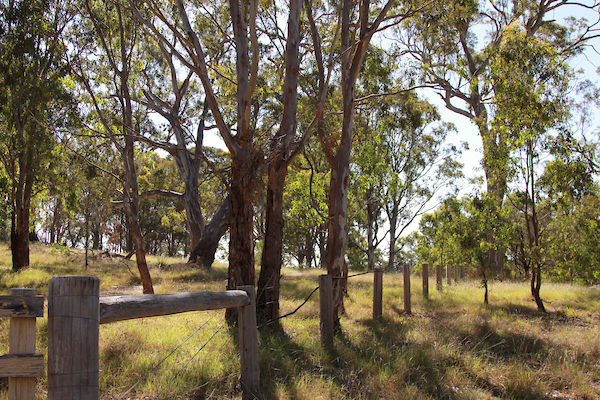
Black wattle, Acacia mearnsii, a small to medium-sized tree (see Fig 1), is arguably one of the most adaptable and versatile Australian native species. Adaptable, because it is capable of growing on a wide range of sites, and versatile because it has the potential to produce a large range of products. It has been described as the best example of an Australian tree which is used extensively overseas but almost ignored in its homeland.
Natural occurrence
Black wattle has a wide natural distribution, from near Sydney NSW through to southern Victoria, south-eastern South Australia and Tasmania.
Provenances
Early research results suggest that Black Hill Reserve, Kyneton provenance has good early growth rates in ACT trials. This is supported by early observations on trial sites in Victoria.
Site requirements
It grows on a range of sites, from deep moist alluvial soils in sheltered valleys to low fertility skeletal soils on exposed hill crests. Its natural rainfall range varies from 500 to 1000 mm/year. Black wattle is often cited as a short lived species (15-20 years), but persistence and growth rates are dependant on site quality.
Longer life spans and better opportunity for commercial production can be expected from sites with at least 800 mm/year rainfall and soils with high moisture availability.
Black wattle is easily established by direct seeding and is regarded as a pioneer species ie. one of the first species to re-colonise a disturbed site. In fact, it is often considered a weed in other countries where it has been established.
Growth rates
The species is noted for its fast early growth rates, which can be in the order of 2-3 m per year. Fast early growth rates have led to the use of Black wattle as a nurse species, capable of protecting and assisting in the silvicultural management of slower growing species such as blackwood (Acacia melanoxylon).
Black wattle is a nitrogen fixer that has the potential to improve the growth of other species, such as eucalypts on the same site. Interplanting eucalypts with Black wattle will have the added benefit of improving biodiversity by attracting insectivorous birds and mammals such as sugar gliders.
Management
Establishment methods will depend on the desired end product and the availability of labour and finance. Direct seeding is a cheap method, but allows little control over tree spacing. Favourable seasons can result in high tree densities which may require labour intensive thinning in the first year before the trees become too large. However it can still be a popular establishment method if total biomass production is the main objective, for example firewood.
If specialty timber production is the desired end product, planting is a more suitable method of establishment so that initial plant spacing can be controlled. Planting also allows for selected provenance seed to be used, which is often only available in small quantities. Close initial tree spacing (2-3 m along rows) will help to reduce branch development. Subsequent thinning (which could produce by-products such as firewood) should aim to give trees sufficient space for diameter development. This again will depend on site quality, such that high rainfall, high quality sites will support greater tree densities.
Pruning for clearwood production is advisable if specialty timber is the desired end product. It should be carried out regularly as the species is prone to heavy branching. Form and lift pruning should follow guidelines identified in Bird et al. 1996, and other Agriculture Notes in the Farm Timber series.
Pest and disease risks
Black wattle is susceptible to attack by several insects and fungi, the main threats being the fire blight beetle, borers and gall rust. Severe infestations and attack tend to occur when trees are stressed, so provenance selection and site suitability are critical for successful and productive tree growth. Introducing a range of species into a plantation will also help to improve biodiversity which may in turn increase the range of possible pest predators.
The larvae of the fire blight beetle feeds on wattle foliage and severe infestations can cause complete defoliation. Repeated defoliation in successive years can cause tree death. If the infestation is detected early enough, spraying can prevent severe damage.
Borers have also been observed to attack Black wattle. Incidence of attack is greater where trees have been damaged or wounded or when they are stressed for other reasons such as drought. Control of borers is difficult.
Gall rust fungi is common on Black wattle in central Victoria. Brown swellings on branches are a reaction to fungal infection. Little is known about the life cycle of the fungus, and there is no direct means of control. It is advisable to remove the affected branches from the site. Infection appears to be more prevalent on trees that are old or stressed.
Uses, wood quality and drying characteristics
Black wattle has the potential to produce a wide range of products, including specialty timber, firewood, pulpwood, tannin and posts. It should be noted however, that in many cases markets are not yet developed and new processing industries would be required.
Specialty timber
Black wattle timber, although lighter in colour, is similar to that of blackwood, which has established timber markets. It has attractive light brown heartwood with reddish markings and distinctive pale sapwood. It is very hard and tough with moderate strength and durability and fine textured grain, which is often crossed or interlocked. The wood is moderately easy to work and takes a good polish. It is reported to have densities that range from 650-945 kg/m3.
To date, Black wattle processing is uncommon, but reports indicate that it is quite easy to saw and is not prone to collapse or excessive shrinkage when dried. It may exhibit minor surface checks, which can be overcome by slow drying techniques.
Production of sawlogs is only likely to be possible on sites with at least 800 mm/year rainfall and high soil moisture availability.
Fast growth rates, minimal processing problems and attractive timber which is easy to work, make Black wattle a specialty timber option for consideration on high quality sites.
Firewood
Black wattle is an excellent hot burning firewood that was traditionally prized for wood fired bakers ovens. This, along with fast growth rates and cheap establishment techniques such as direct seeding, make Black wattle a popular choice for firewood production. Firewood can also be produced from thinnings from plantations destined for timber production.
Pulpwood
Black wattle is widely grown in plantations overseas, for example South Africa, for pulpwood. It gives high pulp yields with the Kraft method, requires low chemical usage in the pulping process and provides favourable paper strength properties.
As mixed wood chips (of different species) is undesirable, export pulpwood companies indicate that the minimum feasible volume of Black wattle chips they would require would be in the order of 60 000 to 100 000 green tonnes/year. This would require large areas of Black wattle plantations. It is unlikely however, that Black wattle will be established for pulpwood in areas that are suitable for growing Blue gum, (Eucalyptus globulus) which is considered the world's best pulpwood species. In lower rainfall areas which are unsuited to Blue gum, Black wattle growth rates and persistence may suffer.
Tannin
The bark of Black wattle is noted for its high tannin content, 36-44%, depending on site quality. Black wattle bark supported a thriving tanning industry late last century. Among reasons cited for the decline in the Black wattle tanning industry are the increased use of chromium salts in tanning and competing imports of tannin extract. Today there is only one remaining tannery, Greenhalghs Tannery Ballarat, which uses tannin derived from Black wattle grown in Australia.Currently, it mainly uses imported tannin extract but would use more tannin derived from bark stripped from Australian grown stands if it was available.
In 2000,Australia imported approximately $7 million worth of powdered tannin extract derived mainly from Black wattle plantations in South Africa. The bulk of this is used in the production of wood adhesives for the reconstituted particle board industry.
Industry development for tannin production is dependent on development of a tannin extraction processing industry and innovative methods for bark stripping to compete with low labour costs overseas. The absence of a large Black wattle plantation resource that would guarantee a raw product, and fierce competition on the world tannin market driving prices down, suggest that investment in tannin processing would be unviable.
Posts
As the sapwood of Black wattle absorbs preservatives well, treated posts are a potential product for on farm use or for sale into recently expanded industries, for example the vineyard industry. Black wattle posts would need to compete with pine and other hardwood posts.
Other uses of Black wattle could include charcoal for industry uses, production of rayon and craftwood. Many of these uses have been implemented to varying degrees with Black wattle and other wattles overseas.
Acknowledgements
This Note has been updated from an earlier version prepared by Trish Kevin, Creswick.
The information in this Note, was obtained from a number of sources (listed below). For further information, refer to the following references.
- Bird P.R., Jowett D.W., Kellas J.D., Kearney G.A. (1996). Farm forestry clearwood production. A manual for south-east Australia. Technical report series. Agriculture Victoria.
- Boland D.J., Brooker M.I.H., Chippendale G.M., Hall N., Hyland B.P.M., Johnston R.D., Kleinig A.,Turner J.D. (1992). Forest trees of Australia. CSIRO Publications.
- Costermans L. (1992). Native trees and shrubs of south-eastern Australia. Weldon Publishing.
- Davidson R. (1992). Bushland on farms. Do you have a choice? Australian Government Press Service.
- Guigan F., Wang Jingxia V., Clark N. B. (1991). Kraft Pulping Properties of Acacia mearnsii and A. silvestris. In: Turnbull, J.W. (Ed.) Advances in tropical Acacia research. ACIAR Proceedings No 35.
- Jaakko Poyry (1999). Feasibility of Black wattle (Acacia mearnsii) for farm forestry in central Victoria, Australia. A study for the Central Victorian Farm Plantation Committee Inc.
- Phelan T.& Higgans I. (1996). Timber growing opportunities for north central Victoria.
- Searle S. (1996). Wood and non-wood uses of temperate Australian Acacias. Proceedings of 1996 Australian Forest Growers Conference. Mt Gambier.
- Searle S (2000). Critical appraisal of Black wattle feasibility study and new information. For the Central Victorian Farm Plantations Inc.
- Thomas S. (1993). Black wattle (Acacia mearnsii) - a re-vitalised industry for Australia. Australian Forest Grower. Special lift out section No 24 Autumn 1993 Vol 16 No 1.
- Turnbull J.W. (1986). Multi-purpose Australian trees and shrubs; lesser known species for fuelwood and agroforestry. ACIAR Monograph No.1.
This Information Note was originally developed by Trish Kevin and Sue Harris and was published in July 2000.
It was reviewed by:
Sue Harris, November 2007
Sue Harris, Farm Services Victoria Private Forestry, November 2008.
ISSN 1329-8062
Published and Authorised by:
Department of Environment and Primary Industries
1 Spring Street
Melbourne, Victoria
This publication is copyright. No part may be reproduced by any process except in accordance with the provisions of the Copyright Act 1968.
The advice provided in this publication is intended as a source of information only. Always read the label before using any of the products mentioned. The State of Victoria and its employees do not guarantee that the publication is without flaw of any kind or is wholly appropriate for your particular purposes and therefore disclaims all liability for any error, loss or other consequence which may arise from you relying on any information in this publication