![]() |
Ironbark
Eucalyptus tricarpa Eucalyptus sideroxylon
Species attributes
Ironbark is a medium to large eucalypt with distinctly corrugated bark and striking flowers. It is hardy, long-lived and has significant shelter and wildlife value. Ironbark is becoming increasingly popular as a fine furniture and joinery timber due to its deep-red, brazen wood that possesses excellent durability and strength. It is a successful plantation species with strong coppice ability.
Traditionally the ironbark timber was utilised by the aboriginal people for tarnaks (bowls) and sturdy shields. The roots of the tree were used for fashioning heavy boomerangs. During the goldrush and settlement of the Box-Ironbark region, red ironbark was of importance for fuelwood, and its exceptional durability and strength proved invaluable for heavy construction. Eucalyptus tricarpa is indigenous to the north central region.
|
Wood and timber products
|
![]() ![]() |
|
|---|---|---|
|
Craftwood
|
Limited to select pieces | |
|
Veneers
|
Good future prospects | |
|
Furniture
|
Excellent turning and joinery timber | |
|
Flooring
|
Hard wearing | |
|
Construction
|
Outstanding structural timber | |
|
Fencing
|
Posts and droppers (including electric) | |
|
Firewood
|
Slow burning at high temperature | |
Market potential
Due to the red colour of the wood, its durability, strength and wide range of applications, ironbark is one of the regions best timber species. These features, combined with its tolerance of frost, drought and a wide range of conditions, has lead to increasing interest from farm forestry and plantation investors. Recognition of ironbark as a specialty timber is on the increase in Australia and overseas.
| Eucalyptus tricarpa and E. sideroxylon have considerable potential for farm forestry throughout the region. |
Species description
![]() |
Red ironbark E. tricarpa (L. Johnson) and mugga ironbark E. sideroxylon (A. Cunn. Ex Woolls) are medium to large trees with characteristically rough fissured bark that is deep grey to jet-black in colour. The tree is long-lived, straight in form and commonly grows between 15 and 30 metres in height. The lance-shaped leaves are bluish green with a distinctive midrib and scarlet red tones on the petiole attachment. The foliage of sideroxylon is often a glaucous grey whilst that of tricarpa is a darker green. Leaves may extend to 15 centimetres in length and 3 centimetres in width.
The colour of the flowers range from a pale yellow to deep pink or crimson, and hang between the leaf and branch axil from a shared slender stalk, generally in clusters of three for E. tricarpa and up to seven for E. sideroxylon. The calyx tube holding the flower is longer than the conical cap protecting the flower before blossom. Flowers open to 25mm across and fruit development post-fertilisation produce goblet shaped seed capsules, around 10mm in length and width, with deeply enclosed valves. E. tricarpa capsules tend to be larger than those of E. sideroxylon. As the capsule matures and the seed ripens, its colour turns from a polished lime green to a dry dusky maroon. Seed in woody capsules of this colour can be collected throughout the year.
| Other products | |
|---|---|
|
Oils
|
Essential oils extracted from leaves |
|
Honey
|
Substantial yields and high quality |
|
Paper
|
Fine writing papers |
|
Mulch
|
Excellent bark mulch |
|
Seed
|
$300 to $400 per kg uncleaned |
Flowering period
Most ironbarks flower during late winter or spring, though some flower in the summer to autumn period.
Plant propagation
![]() |
![]() |
When collecting seed, select from healthy and vigorous specimens with desired form. Preferably harvest from a minimum of 10 parent trees over a substantial area within a natural stand.
Capsules collected should be dried to release the seed. Once released, the seed may require cleaning through a sieve to separate them from the chaff (aborted ovules). Placing seed in a glass of water is a basic test for seed viability. The seeds that sink are usually viable and those that float to the top can be discarded or sown into a ‘test’ tray. To germinate, sprinkle the seed evenly over trays or directly into cells containing a suitable seed-raising mix and cover lightly. For successful germination, a temperature of around 23°C and adequate light and moisture will be needed. Take care when watering so as not to dislodge the seed. Germination of viable seed usually occurs within three weeks.
|
Seed viability
|
High
|
|---|---|
|
Pre-treatment required
|
No
|
|
Optimal germination temperature
|
23°C
|
|
Seeds per gram (approx.)
|
250
|
Clean seed should be stored away from sunlight in a cool dry place with adequate protection from insects and rodents. A sachet of naphthalene or a dusting of a pyrethrin-based insecticide may be useful if seeds are to be stored in a container or bag. To date direct seeding of this species hasn’t proven reliable.
Natural distribution
![]() |
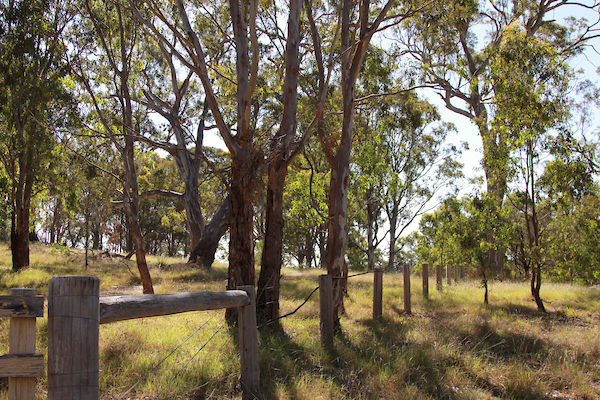
In central Victoria Eucalyptus tricarpa occurs on the low ridges and undulating country that extends inland of the Divide. It is also found in the near-coastal regions of southern Victoria, Gippsland, and south eastern NSW. Eucalyptus sideroxylon occurs naturally east of Benalla, and continues through New South Wales and into southern Queensland. Ironbarks are usually confined to the drier stony hillsides, with relatively poor skeletal soils combining sands, gravelly quartz, ironstone and clay. Occasionally they are found on flatter, alluvial terrain with moderately heavy clayloams. Ironbark occurs in localities that receive rainfall within the 400 mm to 1000 mm band below an altitude of 550 metres above sea level. Within the North Central region E. tricarpa is common in the Box-Ironbark forests of the central goldfields area, though little old growth remains. Its distribution has been diminished due to clearance primarily for agriculture and to a lesser extent mining. Most remaining forests are comprised of coppice regrowth. The associated overstorey may include box and stringybark species on the ridges, cypress-pine, mallees, red gum and yellow gum on flatter terrain (Eucalyptus leucoxylon a closely related species may hybridise with ironbark to produce offspring with shared traits). The understorey is often rich in herbaceous species, grasses, and a moderately dense shrub layer, including wattles.
Occurrence in North Central Victoria
Whilst E. tricarpa is indigenous to central parts of the region, E. sideroxylon is widely planted and both species can be found in landscapes of varying soil type, aspect and climate. Ironbark is a popular tree in urban areas, along roadsides and as a woodlot or shelterbelt species in rural districts.
Site preference
Ironbarks are versatile trees with excellent drought tolerance and resistance to damage from frost and fire. Ironbark grows best on the deeper clay loams but can adapt to a wide range of soils and will tolerate saline and moderately waterlogged conditions.
Silvicultural characteristics
|
Recommended establishment density
|
|
|
1000 trees per
hectare and grea |
4 x 2.5 m or
3.3 x 3 m spacings |
![]() |
|
The wide and fragmented distribution of these species has lead to significant genetic variability, and little provenance testing has been carried out to date. Guidance as to the selection of seed for plantation purposes is therefore currently lacking, and higher establishment densities are recommended to allow a greater degree of selection through thinning. It is important to ensure seed has been collected from good trees and that provenance information is recorded. These species generally selfprune and exhibit good forest form. Natural regeneration is unusual as seed fall, adequate ash-bed and rainfall conditions rarely coincide.
Establishment costs
Cost estimates for planting of 1000 trees per hectare.
| Soil preparation | $200 |
|---|---|
| Weed control | $100 |
| Seedlings | $400 |
| Planting | $150 |
| Guards | $300 |
| Guarding | $200 |
| Total | $1350 |
Although the foliage is not particularly palatable, seedlings should be protected from grazing animals.
Pests and diseases
![]() |
In a tree’s natural habitat insects and diseases are continually present, and a certain amount of damage can be expected in plantations. In the longer term a balance is usually achieved and tree growth sustained. Often a decline in tree health is the culmination of various stresses. Imbalance for example, may result from severe insect attack combined with extreme environmental conditions such as prolonged drought. Weakened trees will prove more susceptible to pests and diseases. Select healthy trees and aim to minimise impacts by reducing competition through thinning.
Wood
The wood of ironbark has good resistance to decay. The lyctid borer may occasionally attack the sapwood.
Foliage
Common pests of ironbark include the steel blue sawfly and lerps, though trees may host a number of other sap-sucking and leaf-feeding insects. Galls are considered relatively minor problem on eucalypts.
Sawflies (Perga spp.) are common insect pests of eucalypts over spring and summer. The term sawflies is partially misleading as these insects are actually large wasps that deposit their eggs in the leaves with a saw-like instrument attached to the abdomen of adult females. The larvae are often called spitfires due to their habit of ejecting an irritating yellow liquid when disturbed. Spitfires cluster together on branches in large groups during the day and disperse to feed on foliage at night. They have a voracious appetite and can cause considerable damage. Small trees are occasionally defoliated. Spitfires, when fully grown, leave the tree en masse to pupate, burrowing into loose soil from which they construct individual cocoons. In younger plantations the simplest method of control is to remove and destroy the larvae by pruning off the branch to which the colony is attached. Spitfires group together primarily for protection as they have a large number of natural predators. Lerp insects (psyllids) construct a sugary white shell-like structure (or lerp) on the leaf surface under which they shelter and feed. Usually lerps are fairly inconspicuous though periodically their numbers increase, submitting the host plant to a cycle of defoliation and recovery. These outbreaks may last for 2-3 years while environmental conditions are favourable. Severe infestations may cause some dieback and combined with other stresses may seriously weaken the host tree. Relying on natural predation is currently the only practical form of control.
Timber characteristics
![]() |
![]() |
Appearance
The attractive heartwood of Ironbark is a dark earthen red and polishes to a deep resin colour. Older trees yield darker heartwood. Plantation grown timber will be of lighter colour. The sapwood is dusty yellow, and usually comprises only a small percentage of the total wood volume. Growth history is reflected in the characteristics of the timber and fiddleback may feature in the wood of certain trees.
Shrinkage & Drying
Shrinkage is indicated by the difference between the green and air dry density and is due to moisture loss from the timber on drying. With ironbark this is moderate, about 3.5% through, and 7% across the face of back-sawn boards. Ironbark is relatively slow to air dry. Care must be taken during the drying process to minimise surface checking. It can usually be air-dried without significant degrade if handled efficiently and carefully. Log ends should be sealed. Ensure facilities are appropriate for correct stacking of sawn wood. The timber should be evenly stacked to allow free circulation around each piece and positioned level, with sufficient clearance from the ground. This will enable a balance in the air and moisture circulation during the drying or seasoning process. Ironbark can be successfully kiln dried.
Hardness & workability
Ironbark is an exceptionally hard and strong timber with fine interlocked grain. It has Class 1 durability rating, and though the timber is difficult to work, it polishes well. Ironbark is one of the strongest timbers in the world and its resistance to wear makes it suitable for a range of applications. Its uses extend from quality indoor and outdoor furniture, flooring and decking, poles and posts, stair treads and benchtops, to heavy construction work. The strength of ironbark allows for joinery and fine furniture designs without compromising robustness, although some difficulties may be encountered with gluing. Ironbark can be sliced to produce veneers.
![]() |
||
| Green density 1 | 1210 kg/m3 | |
| Air dry density 1 | 1140 kg/m3 | |
| Durability 2 | High (Class 1) | |
Product specifications
![]() |
Sound logs with a diameter of 300mm or more under bark are suitable for milling. Sawlogs are preferably green, between 2.4 and 3.6 metres in length with the bark removed. Sapwood can be retained for most applications and percentage recovery of timber from logs is typically high. Sawn timber can be used green for many applications including fencing, posts, construction and decking. Where necessary, allowance must be made for shrinkage. Shorter lengths and smaller diameters are suited to posts, palings and droppers. Ironbark timber can be air dried to 17-20% moisture content. Kiln drying to 8 – 12% is essential for higher value markets such as fine furniture and flooring. Timber is preferably air dried before kiln drying. Processing costs for milling of high value timber is $160 - $240 per m3. Kiln drying green timber under contract costs $300-$600 per m3.
Markets
![]() |
Ironbark is considered a premium species, with established markets for both wood and timber products. Its colour, strength and durability are highly marketable attributes, and recognition in both domestic and overseas markets is on the increase.
Currently, kiln dried timber retails for $1600 to $2200 per m3. Choice dressed pieces may sell for higher prices. Structural grade timbers sell for $650 - $1600 per m3 either green or air dried.
Within the region red ironbark is harvested from natural stands. A mill located at Rushworth handles the majority of this timber. This mill processes on average 700 m3 of sawlog per annum, producing 320 m3 of structural grade and 160 m3 of kiln dried furniture grade timber. Current government royalties for ironbark logs are $30 – $80 per m3.
Dry firewood currently fetches $50 - $100 per tonne, although production costs are high.
Risks
![]() |
![]() |
Relative to other potential plantation species, ironbark is considered a low risk option for farm forestry investment in the region. Although total production volume is low in relation to other native hardwoods such as ash and messmate, ironbark offers greater flexibility via a large range of product and market options, and has a well-established place in the specialty timber market. Ironbark is increasingly being sought after for specialty, high value uses. Not only is its distinctive, red timber in demand, markets also exist for small dimension and roundwood products, improving the likelihood of a commercial thinning operation, minimising waste, and potentially increasing overall returns.
Currently within Australia, ironbark logs are almost exclusively sourced from native forests, though these species are being grown in plantations overseas. The attributes of plantation grown timbers will be distinct from that of native forest resources.
To minimise risks, growers should aim to manage their plantations to produce quality products for premium markets, and participate in the marketing and promotion of the species.
References
1Keith R. Bootle Wood in Australia McGraw-Hill, 1983.
Tuesday Phelan and Ian Higgins Timber growing opportunities in North Central Victoria DNRE, 1996.
Neville Bonney Economic Native Trees and Shrubs for South Australia Greening Australia, 1997.
Leon Costermans Native Trees and Shrubs of South-Eastern Australia Landsdowne, 1998.
G.M. Cunningham, W.E. Mulham, P.L. Milthorpe, J.H. Leigh Plants of Western New South Wales N.S.W. Government, 1981.
P.R. Bird, R.B. Dickmann, K.N. Cumming, D.W. Jowett, G.A. Kearney Trees and Shrubs for South West Victoria Department of Food and Agriculture (Tech. Report 205), 1992.
D Jones, R Elliot Pests, Diseases and Ailments of Australian Plants Lothian Publishing Company, 1986.
P Zborowski, R Storey A Field Guide to Insects in Australia Reed Books, 1995.
Greening Australia Victoria Indigenous plants for North Central Victoria: a revegetation guide,DNRE, 1998.
N Hall, R.D. Johnson, G.M. Chippendale Forest Trees of Australia AGPS, 1975.
D.B. Foreman and N.G. Walsh Flora of Victoria Inkata Press, 1993.
G.C. Marks, B.A. Fuhrer, N.E.M. Walters Tree Diseases in Victoria Forests Commission Victoria, 1982.
M.R. Jacobs Eucalypts for planting FAO Forestry and Forest Products Studies, No. 11, 1981.
2CSIRO Revised Natural Durability Classification CSIRO, 1997.
Acknowledgements
Neville Bonney, Greening Australia, South Australia.
Dr Eugene Dimitriadis, Xylo-australis.
Gary Waugh and Russell Washusen, CSIRO Australia.
Jeff Watson, Watson’s Ironbark Timber Products.
R and E McDonald, Apiarists Castlemaine.
Des Stackpole, CFTT.
Suzette Searle, Forestry Consultant.
Trish Kevin, DNRE.
Paul Haw, Vens Creek Nursery.
Ralph Hume, Koori information.
Malcolm Thompson, DNRE Swan Hill.
Ian Higgins and Maree Platt, CLPR Bendigo.
Charlie Bovalino, Bovalino Fine Furniture.
Belinda Measkii Pastoral and Veterinary Institute, Hamilton.
Wes Risstrom, G. Risstrom and Sons, Millers, Rushworth.
Forestry Victoria DNRE.
Frank Musk, Tablemaker.
THIS PROFILE WAS DEVELOPED BY BEN BOXSHALL, FARM FORESTRY NRE BENDIGO AND TIM JENKYN, HORTICULTURE DEPARTMENT BRIT. FOR MORE INFORMATION PHONE NRE ON 5430 4444.